Solid Waste Management (102907/CE531M)

RajagiriTech
Enrollment is Closed

About This Course

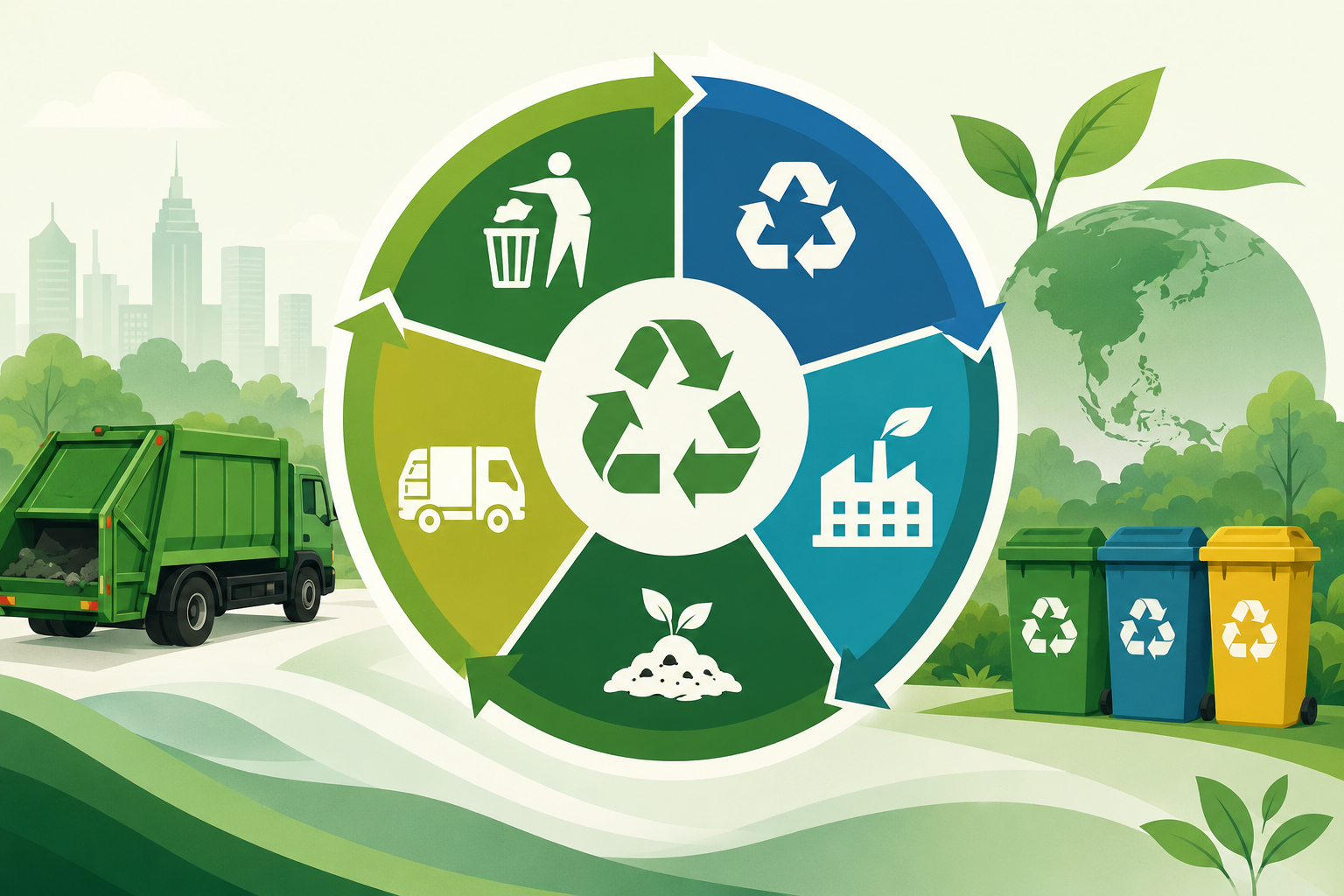
This course provides a comprehensive introduction to the principles and practices of solid waste management, an essential component of sustainable environmental management and urban development. Learners will gain an understanding of different types of solid waste, their sources, and the environmental, health, and economic impacts associated with improper waste handling and disposal.

The course covers waste generation patterns, source segregation, storage practices, collection and transportation systems, and various waste processing and disposal methods, including composting, vermicomposting, biomethanation, incineration, and sanitary landfilling. It also introduces the role of the informal sector in waste management and discusses challenges related to final waste disposal.

Emphasis is placed on sustainable waste management practices through the application of the 3Rs (Reduce, Reuse, and Recycle), plastic waste management, e-waste handling, community participation, and government initiatives such as the Swachh Bharat Mission. Through real-world examples and case studies, learners will develop a practical understanding of effective waste management strategies and their role in creating cleaner and more sustainable communities.

Requirements

Nil

Course Staff

Ms. Nimisha Mathew

Ms. Nimisha Mathew completed her M.Tech in Traffic and Transportation  Engineering from College of Engineering Trivandrum in 2013. She completed herB.Tech in Civil Engineering from Sree Narayana Gurukulam College of Engineering, Kolenchery in 2011. She was working as Assistant Professor in Sree Narayana Gurukulam College of Engineering during 2013 to 2017 and FISAT, Mookannoor as Assistant Professor during 2017 to 2021. Her areas of interest are Transportation Planning and Traffic Management. 

Ms Hema M

Ms. Hema M completed her graduation in Civil Engineering from Sree Narayana Gurukulam College of Engineering, Kadayiruppu in 2010. She went on to pursue her M.Tech in Geotechnical Engineering from College of Engineering, Trivandrum. She worked as an Assistant Professor in Civil Engineering in Mar Baselious Institute of Technology and Science, Nellimattom, for a period of 1.5 years.

Ms Archana C P

Ms. Archana C P completed her Bachelor's degree in Civil Engineering from Government Engineering College, Thrissur in 2012. She holds a Master’s degree (M.Tech) in Environmental Engineering from the College of Engineering, Trivandrum. With a total of 8 years of teaching experience, she has served as an Assistant Professor at various reputed institutions, including KMEA Engineering College, Aluva; Ammini College of Engineering, Palakkad; and Toc H Institute of Science and Technology.

Syllabus

Module 1: Introduction to Solid Waste

Definition and types of solid waste - Municipal, industrial, biomedical, e-waste, agricultural, etc., 

Sources of solid waste - Residential, commercial, institutional, construction, 

Impact of improper waste management - Environmental, health, and economic consequences, 

Introduction to waste hierarchy - Reduce, Reuse, Recycle (3Rs)

 Module 2: Waste Generation and Storage

Waste generation trends (global and Indian context), Factors affecting waste generation, On-site handling and storage of waste, Community-level practices in waste separation and storage, Importance of segregation at source

 Module 3: Collection and Transportation

Waste collection methods - Door-to-door, community bins. Primary and secondary collection systems, Types of collection vehicles, Role of local bodies and waste collectors, 

Case examples of efficient waste collection systems

 Module 4: Waste Processing and Disposal

Overview of waste processing methods - Composting (aerobic and anaerobic), Vermicomposting, Incineration, Biomethanation, 

Landfilling - Sanitary landfills vs. open dumping, 

Informal sector in waste processing (ragpickers, kabadiwalas), 

Issues in final disposal and environmental concerns

 Module 5: Sustainable Waste Management Practices

3Rs in action - Examples from households, institutions, and industries, 

Plastic waste management and single-use plastic ban, 

E-waste and hazardous waste management (basic introduction), 

Community participation and awareness campaigns, 

Role of government policies and Swachh Bharat Mission